15/04/2023 Hoo Zoo, Telford

Badger: Gary from work guested we visit Hoo Farm which is a small zoo located in Telford. They do have some captive birds and animals on site in eluding wolves, caracal's, clawed otters, racoon dogs swell as an array of giant anomatromic dinosaurs. 

And amongst the captive exotic animals and plastics dinos's they have a brilliant photograph hide where you can photograph wild badgers from located within the zoo. There is a badger sett within the zoo where a group of badgers reside forming an underground network. Every Saturday the zoo organises a badger watch from within the hide from 5pm to 8pm. 
There is also other wildlife to be seen as well like foxes however on both occasions, the foxes did not appear. The first visit was good as I got some good sightings of the badger and was the first time I had ever seen a badger

There is also other wildlife to be seen here as they have had foxes occasionally take advantage of the free food put out to entice the badgers. However on this occasions, the foxes did not appear. I loved this, the hide was well presented with both glass viewing area and open windows which give good coverage of the sett. 
The young lad leading from the zoo who was leading the guided tour was excellent, friendly and knowledgeable and the badgers were simply suburb. 

We had three badgers in total, including this big female who was the start of the show. It was obvious that she was brooding a little of young in the sett somewhere and was clever enough to come out first and feed for the longest. She came out around 18.45 and the others came out around 20.10. 


I'll be coming back. Thanks for organising this Gary lad, big thanks. 

12/03/2023 My Garden, Abram, Wigan

Willow Warbler: Before the winds picked up and the sun packed up and I was logging on to the work laptop I heard a melancholy, descending song of falling notes, the sound of summer coming from the willows on the otherwise of my garden fence.


This was the familiar song of the willow warbler, a first for my garden list and a welcome visitor possibly all the way from Africa. 


My garden has taken a bask seat to spending time with Autumn and work, as a Senior Ornithologist Im more busy now than I have ever been with work. But good busy, not like the other places I've worked. 


The bird was forging and singing along my fence line and my neighbours before alighting and flying over the house and out of view. 

11/04/2023 Zinc Works Road, Seaton Carew

Twite: After a very excellent Easter bank holiday weekend I found myself working up near Middlesbrough again today pondering the idea of a four day weekend being the holy grail to a peacfull life. 

My day started at the bottom of Zinc Works Road just off Tees Road past RSPB Slatholme where there has been half a dozen twice kicking about over the last few weeks. 
These small finches feed predominantly  on seeds and here some nice folk has been regularly seeding a small area to encourage them down to feed. They are a real coastal speciality although some breed on moorland. 
As is so typical thesis days the UK's twite population has dramatically declined in recent years, particularly in England where they're on the brink of extinction as a breeding bird. In winter, numbers are boosted by migrants from continental Europe. 
Twite often spend the winter on coastal saltmarshes, where they form flocks and sometimes join groups of linnets. This small flock was doing just that, having around with the linnets and goldfinches and forming large flocks to feed on the seeded area. 
Twite are small finches, about the size and shape of a linnet. They have a very short, stubby yellow beak. They're brown on the back with darker streaking, and paler buff-white on the belly with more streaking on the breast and flanks. 

In summer their beak is grey, but it turns yellow for the winter. Their face and upper breast also become a richer orange-brown in winter. Males can be identified by their pink rump.

Here is a good comparison of both twice and linnet.
With some patience and the right fieldcraft you can get partially close to these birds as they would drop in close and and being to feed feelings after as the feeding flock grows. 
I never thought I would be views like this, when I arrived they were pretty distant perched on the barbed wire fence and high in a nearby tree. But once I noticed the seeded area next to a tall wild mustard plant I sat quietly for most of the morning watching the mixed flock come and go. 
Most of the twice were cooler ringed a scheme designed to give data that is being used in studies addressing population structure, migratory connectivity (relationships between groups over time and space), flock fidelity (relationships between individuals within groups) and population genetics. 
These elements all provide important information on how the birds interact with each other across the European distribution, exchange genetic information and respond to conservation management implemented on both breeding and wintering grounds.
Dunnock: The twice were associating with linnet but were also joined by chaffinch, dunnock, goldfinch and even skylark. All descending on the seeded area to take advantage of an easy meal. 
I was really enjoying my morning here, went for a walk around the adjacent golfcourse hoping to find an ouzel or redstart. Then I noticed a young lad wearing a lack hoodie and walking a small pack of dogs, around 5 of them. 
I saw this lad take the time to bend down and pick up the dog mess left behind on the dunes from one of his small dogs. he collected it in a black poo-bag before slinging it against the side of the dune. I was indignation was through the roof!!!! 
As we walked away and I crossed over along the same pathway he was walking I counted seven tied up full poo-bags along the pathway in various locations all left behind by this brainless, selfish moron!
I meant just leave to dog mess on the ground if you have no intention of bagging it and taking it away with you, why on earth spend the time picking it up only to dump it on the ground?
Anyway back to the birds, here are the colour rings I noted, (white over red), (white over blue), (dark blue over light blue), (yellow over white), orange over black) and (red over pink). 
I've really enjoyed spending the morning with these charming little birds. 

10/04/203 River Calder, Ossett, West Yorkshire

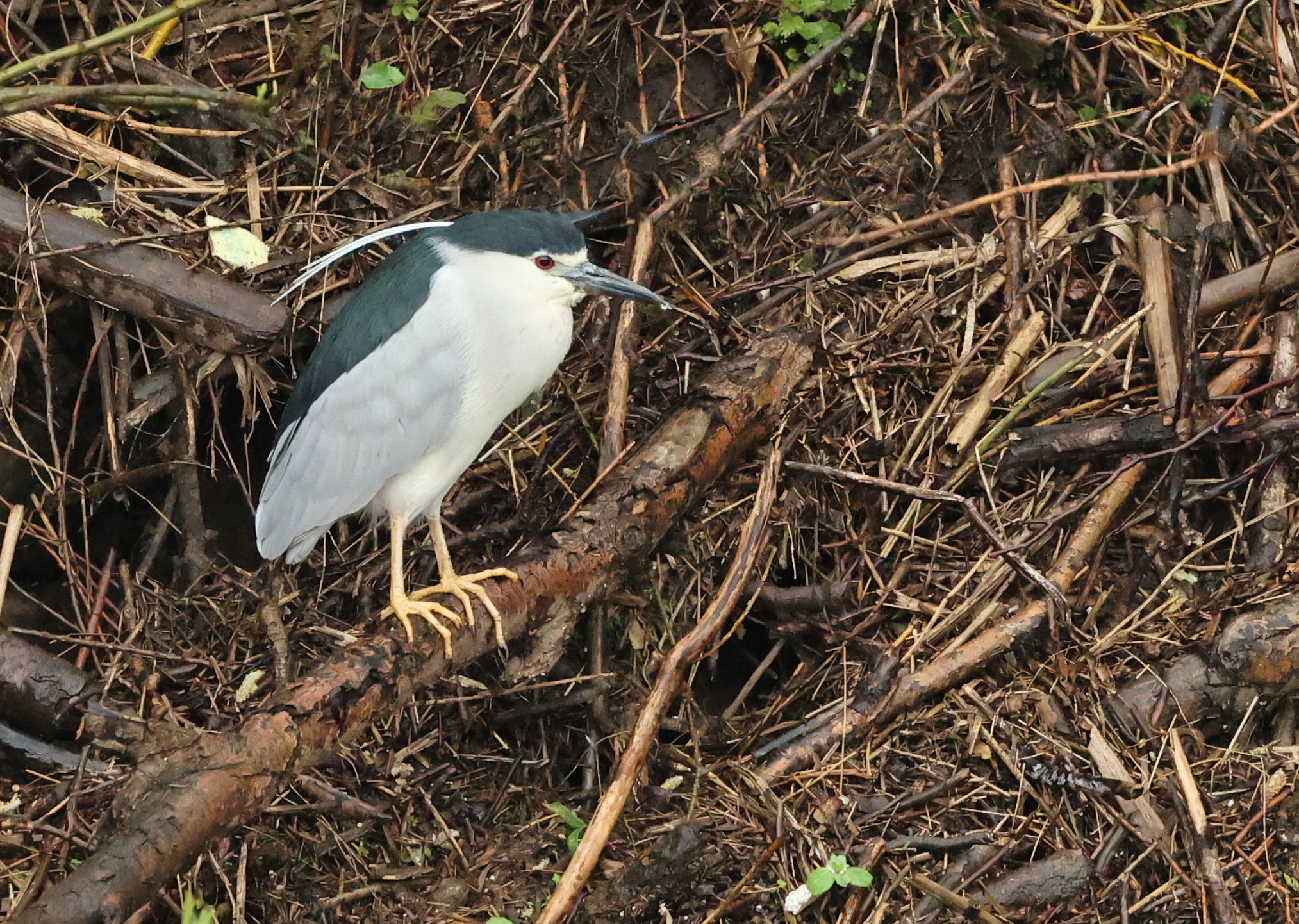
Night Heron: The last day of this brilliant Bank Holiday Easter weekend and I found myself with some more free time, so after complenating my options I though I would go and have a second helping of the night herons over along the River Calder. Joined again by Kristian. 


This time I took my time, had a long lie in and some breakfast before setting off, the plan being that the light and their activity would improve as morning became afternoon. 


Today only one bird showed as the other spent most of its time roosting deep within the large overgrown hawthorn along the bank.

The bird that was on show didn't really do an awful lot as it played status again. 


Night herons are ambush predators using their ability to stand perfectly still at the water’s edge, occasionally even using lures to attract or distract fish. Unlike other herons they have the visual capacity to hunt at night, hence the name. 
The bird occasionally moved around a small area and repositioned itself closer to the waters edge to tack small fish. But on the whole it mainly stood still and did nothing. 
Night herons are down to be historically a scarce visitor to the UK and are a species that are not known to breed here.
Although back in 2017 a pair successfully bred in the UK for the first time in Somerset. The increase in conservation management, particularly of wetland areas in the UK could be the reason we may see more black capped night herons breeding here in the future.
The good light faded and was replaced by menacing rain clouds that soon brought heavy showers. Kristian and I left soaked through while the single bird refused to give me the flight views I was waiting for. 

09/04/2023 Sefton Park, Liverpool

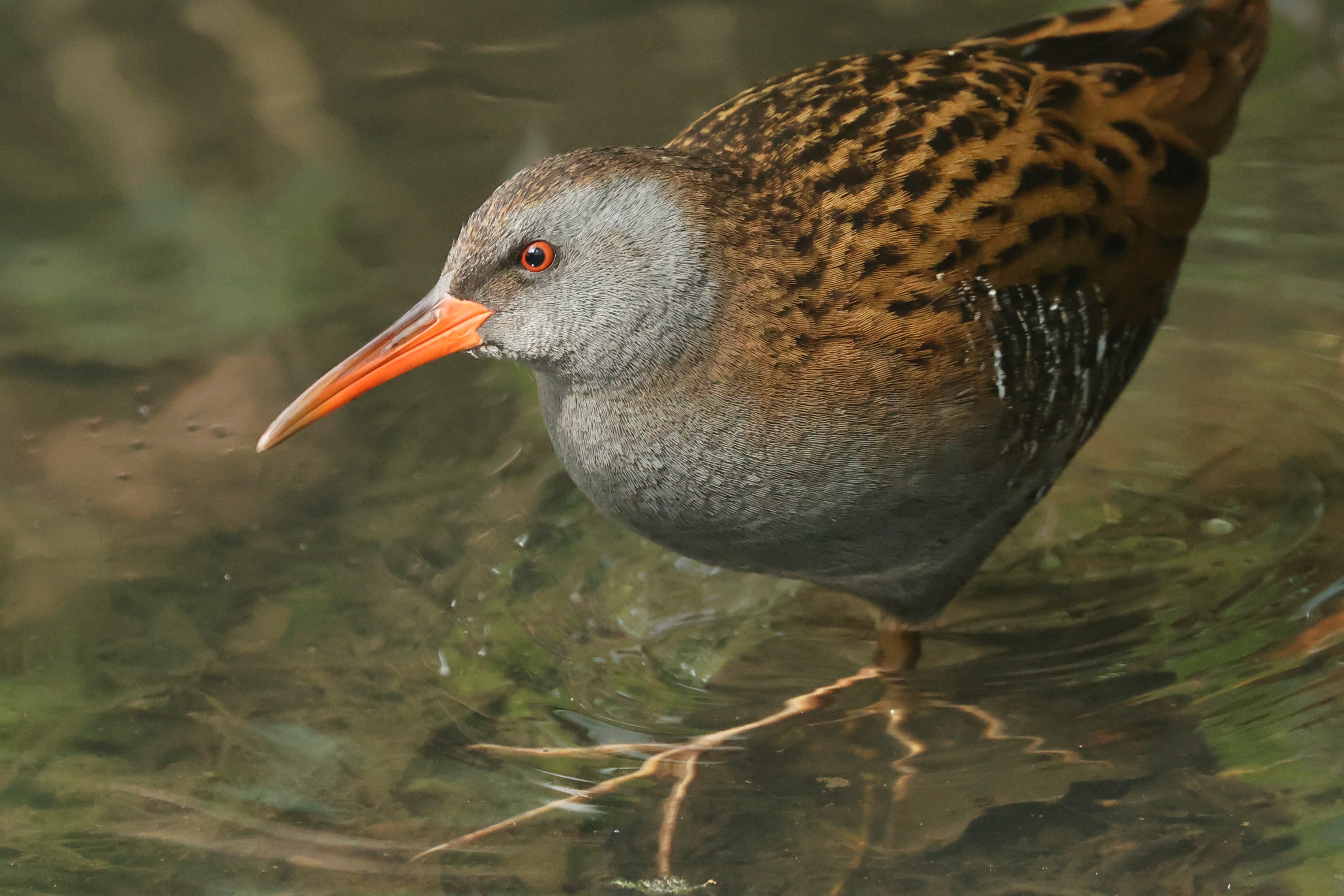
Water Rail: The Easter Bank Holiday weekend continues and before the the Easter meal at mums Dawn and I took Autumn to Sefton Park for a nice walk out and a chance to catch up with the tame water rail that has been in the park for a few months now. 


This 200 acres park is one of the most wonderful greens spaces in all of Liverpool. There is plenty of space here for mixed woodland, grassland, meandering pathways and the parks highlight its beautiful victorian Palm House. 


Besides the glass Palm House the other highlight Stefan park has to offer is a bold and very showy water rail. One that is coming out into the open to feeding in the shallow steams of Fairy Glen regardless of the dog walkers, families and other park users. 
This was my second visit hoping to see the parks star bird and after dipping it last week I was happy to hear It had been seen the day before today. However just as I arrived the bird had been showing well before skulking off back into the undergrowth just before I got there. 
I waited a short while as a small group of other interested birders turns up hoping to se it, some for the first time others their second and third. The bird eventually appeared from under the backside vegetation and walked right out into the middle of the stream and started feeding. 
The small crowed of birders congregated along the shore of the stream and within moments space was a premium here. We jostled and found our own small space and then I lost my footing and performed a two-footed tackle right in to the stream as I slipped. Soggy footed and with a muddy bum, I made my excused and left. Thank to the fella who helped me up and thanks to Pete Brash for his gen. 


08/04/203 River Calder, Ossett, West Yorkshire

Night Heron: With a welcomed long bank holiday weekend on the horizon I was making plans to head into Wales and connect with the black grouse lek at World's End near Wrexham. but news broke the night before of a pair of night heron along the River Calder. 
I couldn't resist the pull so contacted Kirstian and made plans, and early start with the intention of getting their super early just incase they flew off. 
The fact that I could have had a long lay-in, breakfast, mowed the lawn and did the shopping before heading over where I would have got better pictures due to the afternoon light improving never bothered me, well only a little.
Both birds remained remarkably statute like throughout the early morning, they were both still and only moved a few times while we watched them.
Eventually they both moved off and into less visible location, but liker I said early things improved in the afternoon and they bother became a lot more active once we left. 
Red Grouse: We had the whole day ahead ofd us and with north but blue skies above us and free time in out pockets we set off to the Peak District, more specifically Ladybower Reservoir.
Ring Ouzel: Our plan was to pick up some returning ring ouzel and we weren't disappointed, after a proper hike over the moors we were rewarded with a beautiful male ouzel singing away. 
The male was soon joined by a female bird and then we observed another pair in the same area. It was like the M25 up here, hoards of hikers, families and extreme hill runners and bikers so the birds had plenty of company besides me and Kris up here. 
The supporting cast was pretty typical with tons of meadow pipits, red grouse, wheatear and raven. Not going on over the man made moors.
This was a cracking day with near perfect weather great birds and company. 
 

01/04/2023 Elton Reservoir,

Alpine Swift: Another day and another Alpine swift my third in a week after the Doxey and then the Llandudno birds. This time however I was pretty pleased to have one locally, in Greater Manchester.

Upon arriving the bird has disappeared, typically so Kristian and I walked off to try and tog some local dippers before receiving the message that the bird was back. 

It was favouring the fields between Withins Res and Elton Res, we got some point blank views over Withins.
Elton Res has been in the new recently over some controversial plans to build a huge development that they are calling a 'new community' on largely green belt land around Elton Reservoir have been put forward by developer Peel Holdings. The so called 'new community' contains a school and three new roads and 3,500 new homes.

I can only hope that the development is shelved and if not that it is done sympathetically. Elton Res holds a special place in the hearts of many Greater Manchester birders a place known for its passage terns and waders,  scarce gulls and migrant wildfowl.