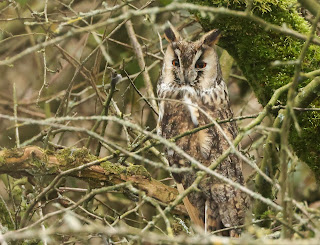
Long-eared Owl: Back again for another session with these marvellous long-eared owls, after a few failed attempted in the continuing poor weather and heavy rain I was pleases to get a chance in hand out in a clear spell.
However instead of rain we had to contend with rolling fog, thick fog when we arrived dampened our spirits as we thought the poor visibility would affect our ability to view the birds.
Not before long the fog rolled over us and cleared up enough to find two young owls rooting in the open and an adult bird roosting lower down in a pine tree.
They weren't phased by our presences and showed no disturbance behaviour and were calm enough to continue to sleep and continue their begging calls.
It was only when the adults came back with food did they increase their activity. keeping a respectful distance it was pretty incredible how the bird just sat there, preying, sleeping and calling.
Although we never witnessed any actually feeding the adults came in and out several times.
The fog coninually rolled in and out and the sun tried its best to burn through the low clouds, we were lucky as between the brighter spells the birds showed well.
Long-eared owls are pale brownish, with vertical streaks along the breast which are horizontal. Long-eared owls have pale patches on the face that give the appearance of white eyebrows, and a white patch below the bill. They have a black bill, orange eyes, and their legs and toes are completely feathered.
Females are generally darker and more richly colored than males. Juveniles look similar to adults, but have softer, looser feathers.
We had at least eight birds within this small area many of which were juvenile birds some looked more developed than others leading us to believe that these are mixed families.
The female bird remains with young almost continuously for first two weeks, while male brings food for female and young. In latter part of nestling period the female also hunts. Young climb out of nest onto nearby branches after about three weeks and are able to make short flights at about five weeks. Adult male feeds young until they are 10-11 weeks old, when they disperse from area.
As the afternoon drew closer and the early morning light brighten into the day light of the afternoon we witnessed some of juvenile birds were observed actively foraging over the moors and grassland. This could possibly be one of the reasons we saw few feeding visits made by the adults.
They hunt mostly at night, sometimes before dusk, and early mornings, especially when feeding young. They forrage over fields or in open woods, flying back and forth a few feet above the ground locating their prey by sound or by sight, before swooping down to capture it with talons.
The majority of the time we observed the owls they were doing what owls are best known for, sleeping and totally unphased by our presence.
The site is popular with dog walkers, ramblers and cycalists and the path ways and trails cut right between the owls feeding and breeding territories so perhaps they are now habituated to the presence of humans and human activity.
At times the locals were also treated to some fabulous views of the birds flying past them and perched out in the open.
We were lucky that the weather cleared up for us and even luckier to witness long-eared owl behaviour at such close quarters, lets hope that the owls and the site remains safe and these owls hunt, how and disperse successfully.


 Long-eared owl (male): The long-eared owl is one of four native owls in the UK, and one of five resident species here (the additional non-native resident species is the little owl).