13/05/2018 Cilburn Moss, Cumbria

 Lesser Twyblade: (Neottia cordata) The phrase "good things come in small packages" has never been so appropriate, these super tiny lesser twayblades were superb a real joy to behold.


After getting some help with directions from a fellow orchid enthusiast on Twitter, Dawn and I decided to spend the day in Cumbria in search of these tiny beauties.

These tiny orchids are particular difficult to find not just because of its diminutive size, but also because it grows in woodlands in the dark shady, humid sites between and underneath taller plants including heather and bilberry and silver birch.


It was funny as almost soon as Dawn and I stepped out of the car we were approached by two other orchid hunters in search of the tinny twybales.  Asking for directions I pointed then in the right area, not overly sure on specifics myself.


The couple were lovely and very knowledge about orchids and both set off ahead of Dawn and I.


When we arrived there was another person togging the orchids a Mr Dr Richard Bate, another recent twitter follower who has been kind enough to some of his vast knowledge of orchids.


I was stunned to how small these rare orchids are no bigger than 3-4cm tall, the plant is distinctive in having only two leaves (which gives rise to its common name), and these are heart-shaped (hence the specific, scientific name 'cordata').

These glossy green leaves occur about one third of the way up the stem, opposite each other.


Very occasionally there can be a third leaf, growing further up the stem, and below the flowers. The leaves have a distinct central rib (like in this image)


Orchid hunting with my loved one, no better day spent then finding rare and beautiful plants, eating ice cream and sitting in the sun.

07/05/2018 Hartslock Nature Reserve, Oxfordshire

Lady Orchid: (Orchis purpurea) Let me open with a brief introduction to Hartslock Nature Reserve. This is by far one of the most beautiful little places I have had the pleasure of visiting. It's located on the north side of the Thames between Whitchurch and Goring-on-Thames, Oxfordshire. .
The reserve is stunning with breath-taking views of the unimproved chalk downland hills overlooking the river Thames and is full of rare beauties.
 Little Hartslock Nature Reserve has now and its surrounding area a beem designated ‘Site of Special Scientific Interest’ (SSSI) and the whole Goring Gap region is an ‘Area of Outstanding Natural Beauty’ (AONB).

One of the rare orchids little Hartslock is known for its the lady's orchid, second to lizard orchid the lady orchid is the biggest orchid we have in Britain.


The sepals and upper petals are known to be purple, hence the lady orchid adopting the Latin name purpurea. The lady orchid gets its name from its sepals and upper petals shapes as they are known to resemble a lady wearing a white dress and purple bonnet.


The orchid family has adapted wonderfully for cross pollination, with the flowers’ complex shapes primary function being to ensure that its own pollen does not reach its own stigma. In turn insects and other pollinators have adapted to the shape of specific orchids.

Hybrid Lady x Monkey Orchid: (Orchis purpurea x O. simia) Hartslock is famous for the monkey and the lady x monkey hybridised orchids found in recent years.


I've read on the Hartslock Nature Reserve website that back in 1997/1998 they first discovered an orchid rosette that was much more vigorous than a normal monkey orchid. And only it 2002 it flowered for the first time and they discovered that it was a lady orchid (Orchis purpurea).
In subsequent years they monitored several more lady orchid rosettes and a few others that seemed slightly different but it wasn’t until 2006 when one flowered that we discovered that they had something really quite different and very exciting.


Here is a  plant that had the stature of a lady orchid but the flower colour and to a degree shape of a monkey orchid.
So these lady x monkey orchids exhibit features from both original parent pants, for example the hybrids are much larger and more vigorous than the normal monkey orchid and much closer in form to the lady orchid and predominately the hood is strongly speckled, like that of a lady orchid.
 They also have an earlier flowering period, five days after the lady orchids and one week before the bulk of the monkey orchids.
Met lost of friendly visitors while enjoying the blazing heat of the sun and the wonderful spectacle of the orchids. Thanks to those who kept me company, even if for a short while.


Grizzled Skipper: Hartslock is also home to the particularly scares grizzled skipper a butterfly with a checkered type pattern across its wings and the dingy skipper, a duller and but equally scares butterfly.
Both of which I saw along with plenty of brimstone, speckled wood, green hairstreak, small copper to name just a few.
Small Copper: I could have spent hours exploring the orchid patch but in this beautiful setting, sitting in the sun and gabbing away with the locals. But with the bank holiday traffic on my mind I thought I should make a move.
Green Hairstreak: Big shout out to Chris Raper, the wonderful warden of this wonderful Hartslock Nature Reserve. Thanks for pointing me in the direction of the skippers.


Pasque Flower: (Pulsatilla vulgaris) vulgaris alright, they super bright flowers stand out across the swaths of green grasses of the chalk hill.
The golden yellow anthers at the flower’s centre are a perfect contrast to the velvet-textured purple petals. These are worth travelling miles to see, even if these particular flowers are from an introduces stock.
I look forward to visiting again.

05/05/2018 Samphire Hoe Country Park, Kent

Early-spider Orchid:  (Ophrys sphegodes) This species of orchid is mainly found on the south coast of England along the beautiful coastlines of  Dorset, Sussex and Kent. They flowers from late March until early June. It has a preference for locations near the sea, and one of its favourite places in Samphire How in Kent.


So, during my bank holiday weekend while staying at my mums in Essex I took the opportunity to take a drive out and visit one of England’s newest pieces of land, made from chalk marl, excavated from the Channel Tunnel.
Samphire Hoe has quickly become one of the world’s rarest habitats of chalk grassland and a haven for wildlife.
Upon arriving I deposited my donation for the parking and had a chat with some people who worked there who kindly pointed me in the direction of the rare orchid.


"Down by the dog poo bin" they said.


Spot on, right besides the bin were about six spires still in good condition, with another eight or so along the track.
These stunning, curious rare orchids get their name from the spider like shape they form, complete with an abdomen, head and even a pair of eyes.

This appearance is purely coincidental and a man made connection. It has nothing to do with attracting spiders to pollinate it! They are pollinated by small solitary wasps and bees.

Great little plant.


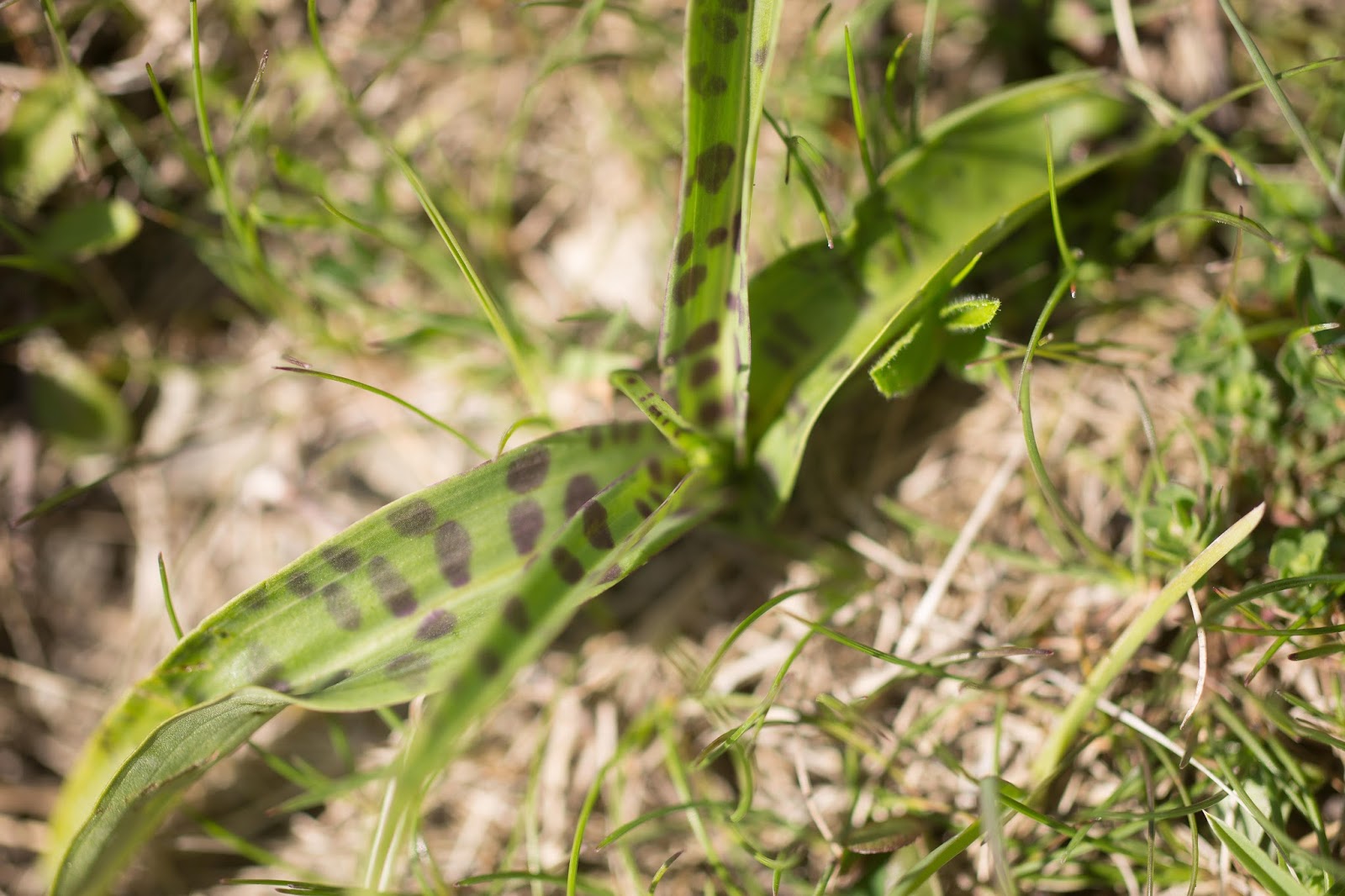
I did spot the beginnings of another orchid and one of particular interest was this orchid rosette. I'm unsure how to tell apart the rosettes of early-purple and common spotted orchids, but the thinner, fleshier rosette here makes me lean towards it being an common spotted.
I did have a long look for the early-spider orchid that lacks most of the anthocyanin that gives it colour and make the plant look pale, almost yellow in appearance (Ophrys sphegodes var. flavescens) but I was able to track it down.


Special thanks to Wild Orchids UK & Ireland @ukorchids who were a huge help giving me reliable information.


Fuerteventura Trip Report

Red-billed Tropic Bird: Damion Young, Gary Edwards, Patrick Earith and I, all North West birders, planned a trip to Fuerteventura to tick off some of its special birds.
The island of Fuerteventura, in the Canary Islands, is home to its own unique endemic bird, the Canary Islands stonechat, and is probably the best place in the world to see the endangered Houbara Bustard.


Houbara Bustard: Three further Macaronesian endemics - plain swift, Berthelot's pipit and Atlantic canary - occur on the island and other specialities include cream-coloured courser, black-bellied sandgrouse, African blue tit and trumpeter finch.

Trumpeter Finch: We had a very successful trip, with all targets except Barbary falcon and the canary seen, and we couldn't ague with the superb view we had of the birds, especially the tropic bird and bustard.
Canary Islands Stonechat: The undoubted highlight was how lucky we got to see the tropic bird at such close range. Possibly one of the best breeding birds in Europe.
Berthelot's Pipit: If you would like to see a lot more images and read about our trip, please click on the link below or see my holidays trip reports at the foot of my blog.

https://austinmorley.blogspot.co.uk/p/fuerteventura-april-2018.html

29/04/2018 Llanmill, Pembrokeshire

Green Heron: Yesterday this little beaut turned up in the Tory MP's Simon Hart's garden, the same garden that has in the past had squacco heron and purple heron!


Mr Hart and his family were extremely good to let us on to their property to view the bird and even laid on some hot drinks. I would like to extend my gratitude and thanks to him.
The green heron is sometimes called the green-backed heron and is a distinctively small bird that is about the size of a large crow.
This bird is the 6th record for the UK and a first for me.

The bird was pretty mobile at times and spent some time foraging out of view in the iris stems before perching on the logs sticking up out of the pond.


Thanks also to Iggo for driving, nice one pal.

28/04/2018 Venus Pool, Shrewsbury

Green-winged Orchid: Today I had a wedding client met ting in Shrewsbury, typically I wouldn't go that far but this client is an old friend and colleague from my days at Cheshire Wildlife Trust.

After visiting their beautiful venue and having a good catch up I decided to make the most of my time down here and go see if I can find the  green-winged orchids around Venus Pools.
I have only ever been here once before to see the female pine bunting and even then i didn't get a chance to have a good luck round.


After finding the place, which took some doing, I walked around the pools and visited some hides. I spotted the purple flowers from some distance in a nearby field.
They came in two main colours a light pinky purple and a darker purple and stood out in the bright green fields transforming it from pasture in to a wild flower meadow.


These striking orchids are very similar to the early-purple orchids that are much more commonly found, but can be identified by the distinct parallel greenish veins on each side of the hood formed by the tepals on the upper part of the flower.
These veins are never found on the Early-purple Orchid. The colour of the flowers can vary from very pale pink to a much deeper purple.

The leaves of this species are unspotted, mainly in a basal rosette, the uppermost sheathing the lower stem.


This is where the orchid gets its name from, these green greenish veins under the tepals in away resemble wings, made green by the veins.

15/04/2018 Leighton Moss RSPB

Western Yellow Wagtail: This male Western Yellow Wagtail (Motacilla flava feldegg)  or more commonly known as a black-headed yellow wagtail was showing well albeit distant on the other side of the railway crossing at Leighton Moss today.

These awfully poor record shots don't do it justice.
So here is a link to Pete Hines video. Certainly worth a watch.

 www.austinmorley.blogspot.co.uk  https://www.youtube.com/watch?v=eSGsYIh2JjY&feature=youtu.be

15/04/2018 My Garden, Abram, Wigan

Siskin: ****A GARDEN FIRST****

I'm always thrilled when I get a new species of bird in my garden, it doesn't happen all that often, and makes me think the work that I am doing in my very own garden patch is working.
Not only was it a joy to see this siskin enjoying the seed I have on offer, but also watching the pair of blue tits and great tits nest building in their bird boxes. This would be the fourth year for the blue tit and the third for the great tit in the same boxes since Dawn and I bought this house.


I get a huge amount of enjoyment out of watching the birds in the garden, putting out food and watching the birds dart onto the feeders. I know I'm certainly not alone, but I look at my neighbours gardens and don't see any feeders, no bird boxes nothing!

These people must be mad!
Siskin & Goldfinch: The little yellow bird hung around most of the morning, often on its own but would be occasionally joined by some of the local goldfinch.