22/11/2018 Brickwork Pond, Rhyl

Slavonian Grebe: I'm happy to have got this distant shot of the Slavonian grebe that has been in the floating about the Briskworks Pond for the last few days. A record shot was better than nothing as so often these winter visiting birds appear as a distant speck out to sea.


It is estimated that less than 50 pairs breed in Scotland but there have been recent attempts to breed further South, while may more are recorded around the shores of the British Isles each winter.
The bird stayed pretty far out in the middle of the pond, which is more of a lake then a pond despite its name. Even when a remote-control model boat came powering up to it, the bird still remained pretty far out.


Great find by Alex Jones, who was out on a lunch break from work when we came across the bird. Top bloke, top find, top birder.

12/11/2018 Hartlepool, County Durham

Little Swift:  Here we have the 30th record for the UK and a bird I disappointingly dipped back in June 2012, and have never lived it down.

I don't make life easy for myself!
The 2012 bird was the famous New Brighton little swift that stayed for several days before I had a chance of going up to see it and when I did it was the same day it flew off, never to be seen again.
Well, lads I now have gripped it back, and little swift is well and truly on my list.

On the Sunday the bird arrived it was spotted going to roost under the eves of a window on no.12 Cliff Terrace and when I arrived at first light the bird remained at its roost site.


It was remarkable to see the bird so close up and in such good detail.


At 7.30 on the dot the bird flew off its roost site and began forgoing along the prom at Hartlepool Headland.

A very tricky bird to photograph I had to manually focus on each frame and track the bird as it sped through the sky and hawked above our heads and at times came within just 2-3feet of us, too close to focus!!
The bird was showing unbelievably well and remained low. At times it was swooping  around the railings of the prom, right past our feet and even flying along the beach below us! Truly amazing stuff.
Supper little bird.

07/11/2018 Meols, Wirral

Pied Wheatear: The bird had been around for a day or so before there was a picture sent to Allan Conlin to ID.


It was a pied!!!

But it took me almost another full day to catch up with it as I was stuck in work plodding through a long environmental scoping assessment and feeling livid and gripped off as the streams of crippling pictures came through on social media.

I ended up taking some toil and getting up on to the Wirral for around 3 o'clock. But by then the bird had moved off the sea wall and on to the roofs of the buildings near the boating club, and here it stayed for about 35 minutes, while the light faded.

The bird did eventually decide to come down and feed along the sea wall giving the small crowed of people a chance to see it up close and personal.

The light wasn't great at this point, but that didn't matter as the bird flew right up to us and posed.

This is a real local mega bird as this is the 1st record of pied wheatear for Cheshire and Wirral and it has been 21 years since the Seaforth bird. Great find by Richard Ashford.

Pied wheatears spend their winters in eastern Africa (Sudan to Somalia south to north-east Tanzania) and south-west Arabia (Yemen). so its a long, long way from where it should be at this time of year.


Controversially there has been reports since I saw the bird of folk putting down mealworms, supposedly in order to get better images.

The reason this is so controversial is that this practice of putting down artificial food has been blamed in the past for birds becoming too tame and complacent and then being predated.


There is no need to supplementary feed this bird, as you ca see from my pictures and the vast amount taken by others yesterday there is simply no need. It comes close enough. The bird is showing well and finding plenty to munch on.

31/10/2018 Burton Mere Wetlands RSPB

Image may contain: 1 person, bird and outdoor
Water Pipit:  I don't often get myself across to BMW but its still a place I have fond memories of and enjoy going.


Its a place full of familiar faces and top birders.


The bird of the day by a long shot was this water pipit from Marsh Covert Hide, there were also reports of two bearded tits but I didn't have the time to look.

Still it was a nice afternoon out.

26/10/2018 Robin's Lane, St Helens

Rose Colored Starling: After a day of highways England network training course (as it was as dull as it sounds) I had an early dart from work and headed over to see the juvenile rose coloured starling that's taken a liking to a chipshop off Robin's Lane as the bird is best viewed from the alleyway behind the chippy.
We've been lucky in the area as we have had two juvenile rose-coloured starling recently, one in Timperley and now this St Helens bird.

There has been some discussion about whether or not the St Helens rose coloured starling might be the same bird as the Timperley one last week.


Colin Davies has put a few comparison images up on the 'St Helens Now' blog that are well worth a look. See the link below.

 http://www.sthelensnow.com/modules/xhld3/index.php?id=5

Someone continues to put out meal worms, so maybe that's one of the reasons its sticking to this unusually small area and affording excellent


The bird really nice, I would even recommend taking a look at Pete Hines's cracking video. Please see the link below.

https://www.youtube.com/watch?v=wXXYHAFidro

21/10/2018 Treeve Moor, Penzance, Cornwall Gray Catbird

Grey Catbird: Boo-ya, after an eagerly anticipated wait and a whole-lotta luck I have now added grey catbird to my list.

This is the second record for the UK after the Anglesey bird back in October 2001. The bird has been here since last Monday and with the weather changing to northerly winds and colder, clear night I did think the bird might move on without me seeing it first.


But not this time, the bird remained faithful to its feeding foraging site, behind Treeve Moor guest house and showed well without waiting too long.

One thing I wanted to mention was the three blokes who were locals and their complete and utter disregard for other twitches on site, I travelled 724 miles to see this bird and there were at least a dozen other twitches who hadn't seen it before I arrived.


These three local birders not only saw the bird first and kept schtum, but moved to a completely different area to view he bird and purposely didn't tell anyone else. I was disgusted by their selfish behaviour.
Still, lets not have them spoil this twitch, I did see this brilliant bird after all.

17/10/2018 Thurstaston, Wirral ‏

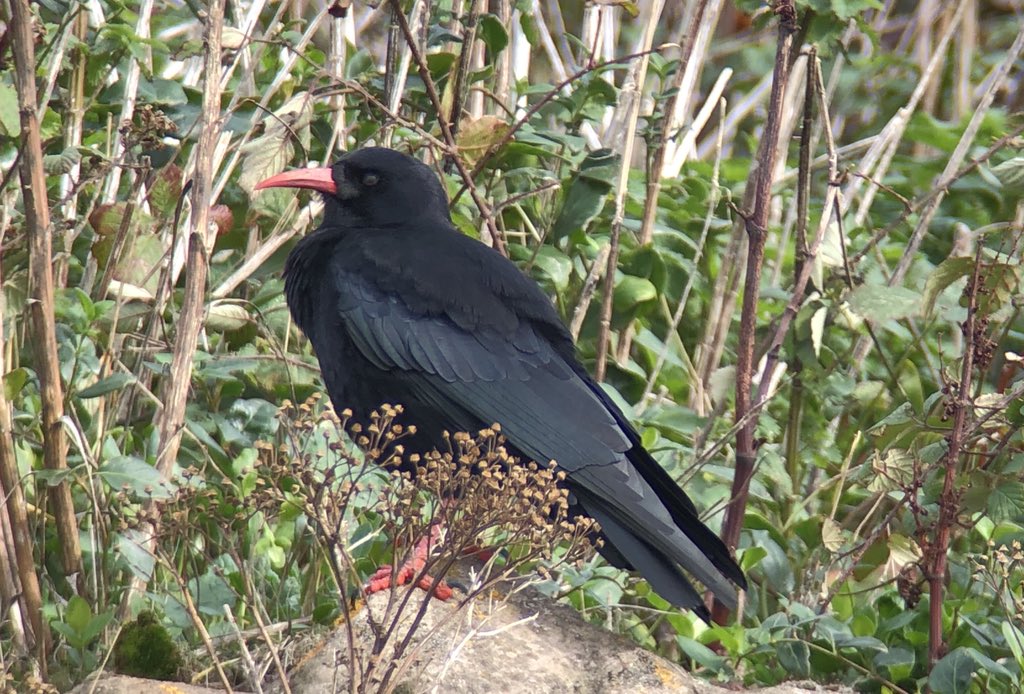
Chough: After working night time road closures on the M56 I had some time banked and decided to spend some of it out birding, specifically to see my first Cheshire chough.


I walked down slipway from top car park of the Dee Sailing Club and bumped in to a few familiar names including Pete Hines, Kenny McNiffe, Chris Challoner to name a few, the bird was showing well on the boulders and cliff faces at on the beach.


According to the Al Conlin this is the 12th chough for Wirral.


07/10/2018 Haltwhistle Cemetery, Northumberland

European Bee Eater: After a very disappointing morning where once again Dawn and I failed to secure tickets to Glastonbury I decided to take the long trip up the M6 and see this little beaut.

A stunning bird and one I've only seen once before in the UK and almost in the same area.
Once I parked up I headed in to the cemetery hoping to find a large crowd of birders and toggers snapping away, but after a 10 minute search I still could find the bee eater or the birders.
I eventually bumped din to another birder who was also on the lookout and also in the wrong place like myself, we realise the bird had moved away from the cemetery and down towards the river.
Here there was about 20 people enjoying the colourful bird on this dull grey day.
While there I was told that the bird has been in the area for 10 days and I could see it was feeling well on a wasps nest in the nearby house.
It was good to catch up with young Elliot and good to hear he is doing well at Carlisle Uni.


22/09/2018 Crosby Marina Lake, Sefton, Merseyside

Grey Phalarope: This morning I woke up to the news that Pete Kinsella had found a very showy grey phal on his local patch only to have a full schedule.
Today was my sisters baby shower in Chester, so I thought I would have no chance and no luck at seeing this bird, I thought by the time I was done it would have been spooked off and flown back out on to the Mersey.
But after filling my face with some lovely cake and hummus finger sandwiches as part of the afternoon tea and playing some dubious baby related games I was thrilled to hear the bird was still there.
Not only on the marina lake but on the small boating lake beside the gigantic one!

I've seen plenty of grey phals but not like this, this bird was swimming right past my lens, my face even, in many cases it was almost too close, if there is such a thing!
Grey Phalaropes are remarkable birds that spends its winters out at sea, feeding around cold current upwellings, where there will be plenty of food. Their migration is entirely over the sea, unlike the other two species of phalarope, which will migrate across land.
And its during the strong windy, stormy weather of September these little birds get blown off course and close to shore and sometimes into marina lakes, ponds and estuaries.
Such a super little bird, especially one so confiding!

16/09/2018 Skippool Creek, Thornton Cleveleys, Lancashire

Semipalmated Sandpiper:  Despite the really poor images I was thrilled to tick off the semi-p down at Skippool Creek, a weird place where small fishing boats are moored on the muddy tributaries which lead into the nearby River Wyre like a boat graveyard.


This is a bird that is notoriously difficult to see its famous wedded feet and is often confused with Least and Western Sandpipers

But upon closer inspection the birds non-breeding plumage with its light grey and very pale lighter belly and black distinguishing this bird from the yellow-legged Least Sandpiper.

Tricky little bird overall, but a very smart one.


(Bottom image courtesy of Damian Young)

Spurn Migration Festival

Common Rosefinch: Spurn MigFest is a real highlight of the my year, top birds, top company at a top place.

And this year was no exception....well the birds may have been lacking a little, with the odd spot redshank, pied fly and redstart scraping the bottom of a poor bird list barrel.
But the star of the weekend and a brand new bird for me was this common rosefinch. Not the  distinctive male with their brilliant, rosy-carmine heads but an otherwise dull, brown, little bird.

Yet still very much the star bird.
For me Spurn MigFest is always remembered by laughs and drinks we have on the Saturday night in the Crown & Anchor with some good friends. However this year I will remember sleeping in my cramped car as my tend got severally flooded out, oh and the rose finch, of course.

29/08/2018 Dungeness RSPB, Romney Marsh, Kent

American Black Tern: This was my second visit to Dunge, after the infamous Arcadian flycatcher and once again it was a brief visit as I needed to head home after working in the area.

This time I was hoping to see the American black tern, a bird I missed only up the road from where I lived back in August 2012 on Eccleston Mere.

My first thoughts were that this was a particularly tricky little bird to pin down across the vast expansive lagoon and the dozen or so European black terns in the area.
But once you see it next to its much more common European cousins you can see that it is distinctive.

It's hoped that the American/European birds will be split which would then give up another life tick, so for now this little guy will sit in the bank.