24/02/2024 My Garden, Golborne, Cheshire

Siskin: Birders are most likely to encounter these agile little birds in coniferous forests and plantations but, particularly in winter they can be attracted to garden feeders. 


These common resident finches have lemon-yellow plumage, long, narrow curved bills (quite typical among Fringillidae) and forked tails. Their striped appearance is what distinguishes them from similar-looking garden birds.


Dawn and I purchased a new house over the Christmas period and although this brings untold stress with packing, moving driving the morals van and then settling in. A new home brings the excitement of a new garden bird list and new visitors to my garden feeders. 
We lived in our old house in Abram for over seven years and I only recorded siskin twice on the feeders.  When we moved into our new house we had an awful problem with the resident squirrels, they were relentless in sniffing out the feeders, damaging them and emptying the seed. 
So, I decided to upgrade the feeders from to the fantastic Roamwild Pest Off Bird Feeder. These 100% squirrel proof feeders have a spring loaded perches that drop when anything heavier than a small bird lands on them, pulling down a door that closes the feeding holes along with large squirrel baffle on the top and above the feeding holes. 

They are great, I've had no more issues with squirrels and plenty of garden birds enjoying the free buffet.


https://roamwildproducts.co.uk/products/roamwild-squirrel-proof-bird-feeders

18/02/2024 Sherwood Forest, Nottinghamshire

Great Grey Shrike: I started the day over in a fantastic woodland, the remnants of an ancient royal forest in Nottinghamshire, Sherwood Forest. 

Meeting up with tom Marshall and Matt Woodward, two legends who I've not seen in far too long a time.  


Made legendary as the home of the famous outlaw in the ballads of Robin Hood this 400 acre forest, surrounded by lowland heathland this is one of the premier places in the UK to see the famously scarce lesser-spotted woodpecker. Our main target for the day although we only had a brief male calling before flying overhead and out of sight. 
We moved on to Buddy Common where we got wood lark singing and this smart shrike. the bird was predictably mobile and ranging across areas without access so it was tricky to get anything decent on it, but good to see all the same. 


Lesser Scaup: After a laugh and chinwag over a cup of coffee and some scran in the visitor centre coffee shop I moved on back home and headed to Woolston in Warrington to try my luck with the lesser scaup.


Dave Spencer refund the lesser scaup  at Woolston Weir after it being found over the bund on Woolsten Eyes NR. The bird after relocating here was in a poor light and at some distance, let's hope it goes back to the Eyes and shows better. 

11/02/2024 Middleton, Heysham, Lancashire

Glossy Ibis: After a busy few weekends without the chance of getting out for a spot of birding I eventually was let out and caught up with the long staying glossy ibis. These birds look so odd like a cross between a heron and a curlew with green and purple-brown plumage. 
Once a rare vagrant to the UK glossy ibis numbers have increased in recent years and it has become more common, with exceptional arrivals in 2007-11. They were even confirmed as a new British breeder in 2002 when a pair was discovered breeding in Cambridgeshire. 


A perfect storm that have created a range of factors are in alignment that have helped the speed of this species. Southern Iberia has experienced extremely dry conditions and a relatively higher winter temperatures across the UK has encouraged large number of glossy ibis to spend the winter here.


This bird has found its winter home on a small flooded pasture field behind a small village near Heysham. Stocked with horses and chickens the flood is pretty extensive and isolated as there's no general access to the fields.  
Upon arrival the bird was at the furthermost side of the pool foraging and probing its long curved big in to the muddy banks.

Eventually, after a short while the bird was spooked by a little eager and flew into the flooded pool opposite the derelict Middleton Parish Hall car park. 
This gave me a chance to get some nice flight shots before it landed and began probing the mud for worms again. 

05/02/2024 Taylor Park, St Helens

Ring-necked Duck: Dave Owen found this smart looking drake RND during his regular wardening rounds of the parks and wild spaces across the area. 

News came out while I was working ut of the Liverpool office, but I managed to make it before the fading light became too much of an issue.


Taylor Park is the largest Victorian park in St Helens named after Samuel Taylor who gave the land the park was built on to St Helens Corporation in 1892. 

Its a nice little park when you look past the obligatory poo bags hanging in trees, such a shame as its a beautiful park! Great children's play ground, boating lake and even a cafe.

RND gets their  name from the dark purple neck band but this is not conspicuous in the field, it catches the light and reflects back, but it its overcast it can be difficult to see. 

They are similar to tufted duck, but lacks the tuft  on the head and has a high crown at the back of the head. They have a grey bill with a white band, a shiny purple head, a white breast, yellow eyes and a dark grey back. 


A scares American vagrant like this pulls in a good crowed of local birders, and it was good to bmp in to some familiar faces. 

13/01/2024 Lunt Meadows, Sefton ecks

Green-winged Teal: Between the family duties around the festive break and now being back at work its took me a while to get myself over to Lunt. 

This yank teal has made itself at home here for a few months now and I'm glad its stuck around so  I could go and see it. The bird was associating with the Eurasian teal on the great-white egret pool at the far end of the site. 

It eventually showed really well after drifting in from the submerged vegetaion and took a power nap on the nearside bank close to the sluice. 

Richardson's Cackling Goose: Another bird that has taken up residence at Lunt, albeit for a much short time so far is this diminutive cousin of the Canada goose, the cackling goose. With stubbier bills, steeper foreheads and a shorter neck they side by side they really do stand out.


Cackling geese that frequently in the wild in the UK, usually associate themselves with either barnacle or pink-footed geese. However there has also been a number of records of birds appearing on their own or with feral geese and these are often assumed to be escaped birds - this may be the case but it is entirely plausible that at least some are wild birds too.


Smew: A good morning spent on the reserve topped off by a drake smew, this bird initially gave me the run around and I saw it fly off from the main lake land on one of the border pools. 

09/01/2024 Heybridge Maldon, Essex

Northern Waterthrush: Local birder Eddie Aldridge first saw the bird when he captured it on a wildlife camera in his back garden and showed it to a man walking nearby, then the chaos broke loose. 
The next day more than a hundred birders braved the damp and dreary weather hoping to get a glimpse, descending on the small village in search of a rare American warbler. They relocated the bird foraging within a ditch close to the house it was first seen. 
 This rare American passerine was one bird I wouldn't have dreamed of seeing this January, the first big big of 2024. So keen to go down I shook off what was my lingering cold and headed down. 

This bird is well at home on this small ditch where it has been roosting at the base of the concrete culvert for over a week. The bird has been fairly reliable, returning to its roost site and leaving each morning before foraging along the damp banks of the ditch and the floating vegetation around the mouth of the culvert. 
This bird is not actually a thrush species but a warbler, one that has a close relationship with its waterside habitats or which comprise of boggy thickets, especially willows and alders, and wooded swamps. At other times, it also frequents mangroves. In migration and winter, it uses a variety of wooded habitats, near water.
The bird gets it name from its thrush like appearance, it is beilved that they resemble spot-breasted thrushes (e.g., wood thrush and hermit thrush) from which they take their name. 

No bigger then a water pipit the Northern waterthrush doesn't look or act much like other warblers, which typically are flitty, fast-moving birds. Perhaps as an adaptation to their ground-feeding habits, they are brown and white and streak-breasted and they walk about slowly on the ground, constantly bobbing their tails. 
The fist recored Northern waterthrush was back in 1985 on St Agnes, Scilly's and the last one in the UK was recored in 2011 again on Scilly so it's been sometime since the last one. 
The bird was relatively close and confiding, despite the large crowds of onlookers, the biggest issue was the weather, cold, freezing an dull, with grey clouds is was difficult to get a high resolution image. I'm not complaining, just always wanting better from my photos. 
Good to see that 2024 is off to a great start, let's hope this is a first of many new ticks for the list this year and a good sign of things to come. 

02/02/2024 Martin Mere WWT, Lancashire

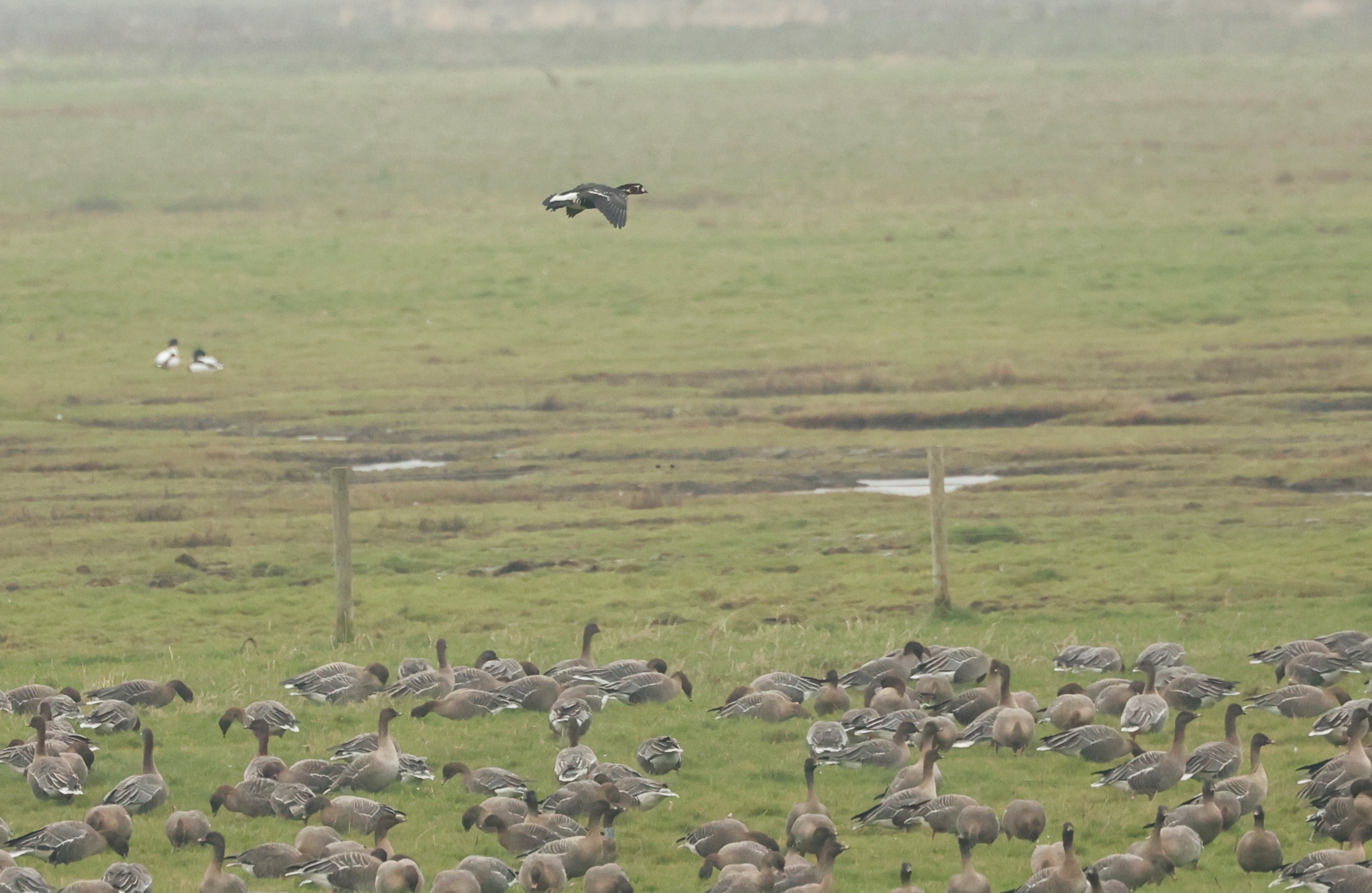
Red-breasted Goose: Happy New Year. Here we are are in 2022 and I ended the year with 25 new lifers, putting me on 450. One of my most successful years with too many highlights to name.
No New Years outing with any birding chums, so instead it was a New Years day trip to Martin Mere with the family. The hope was to see the long staying RBG which was taken up residence on the Mere and I wasn't disappointed. 


Plastic fantastic or the real deal.....?

I saw this same bird back on the 3rd of December, on the edge of a vast salt marsh with tens of hounds of pink-footed geese. Seemingly acting like a truly wild bird, albeit it not with its peered carrier species such as Brent geese or white-fronted geese. 

Now its settled at Martin Mere and is feeding right in the open and close to the viewing screens, foraging on the grassy bank. it still comes and goes with pink-footed geese but now its showing this well.
A lovely looking bird but surely not doing itself any favours regarding its provenance! I know fly who have ticked it and I know some folk who still need it but won't entertain going to see it as its now acting more like one of Martin Meres captive birds.  
After watching the bird I headed back over to the park and collected dawn and Autumn before having a fun and enjoyable walk around the duck pens. 
Brambling: We eventually checked out the other hides were we had two marsh harrier and a nice kingfisher from the Harrier Hide.

Autumn was getting restless so we move don to the Janet Keir Hide.
It was here we had two brambling that were visiting the bird feeders, another reason I chose a New Years walk at Martin Mere. These brambling have been around for a few weeks now and if you get lucky and time your visit right they can be pretty showy.
So another year over and on to the next, what will be the big bird of 2024?

23/12/2023 Crosby Marina, Sefton, Merseyside

Black-throated Diver: With Christmas fast approaching I have been keen to get out and bird, it won't be long and I will be back in work so decided to meet Kristian and had out loacally starting with the long staying black-throated diver at  Crosby Marina Lake.


Black-throated divers are large waterbirds, larger than a great crested grebe but smaller than a cormorant in size. They look smart in their summer plumage, with a black throat, silky grey head and neck, and a black and white-chequered back. In the winter, black-throated divers turn a very dark grey above and white below, with an obvious white patch on their rear flanks. 


In their summer plumage they have vertical white stripes at the side and a short collar of white spots, resembling a barcode. Out of breeding plumage black-throated divers have grey-brown backs with white spots and a white patch on their flanks. They have grey crowns and napes and white forenecks bordered with fine black lines.
It took a short while to relocate the bird, walking in the opposite direction din't help. one we found it the bird was far out from the Activity Centre. 

Eventually the bird kept diving and swimming closer and closer and showed really well. 

If I don't manage to post before the big day let say Happy Christmas to all my blog readers, hope you all have a great day and again, thank you so much for liking on my blog links and reading through my posts. 

03/12/2023 Southport, Merseyside

Red-breasted Goose: Every year migratory wintering geese make the 500-mile journey from Iceland to spend the next couple of months feeding on the arable fields around Southport and east Lancashire. Most of the pink-footed goose population will spend the majority of the winter down south. However, they’ll take a break in their long journey here in Lancashire so that they can refuel for a few weeks before they continue.


On occasion these large flocks of migratory pink-footed geese can pick up and pull in other rare geese species.

There are fewer than 40,000 red-breasted geese in the world and the species is listed as vulnerable on the International Union for Conservation of Nature (IUCN) red list.

Red-breasted Geese are highly sought after in wildfowl collections and are now becoming more prolific in captivity. They have a beautiful and bold pattern of black, white and chestnut plumage and are the smallest of the northern geese.
There is ways discussions of a bird wild validity but this bird is being pulled in with a decent carrier species and associations well with pink-footed geese it looks good so far. 


Snow Bunting: I like Bank Marsh and envy the likes of Stuart Derbyshire (who found the RBG) and who has Banks Marsh as their local patch, not only do they have the chance to find rare geese like this RBG, but they get to see such great spectacle of tens of thousands of geese flocking over the marsh and forming large grazing carpets of geese. 
The long walk down from the car park was pretty productive as we had some large flocks of twine moving between the marsh and the arable fields before connecting with Beth RBG and watching it as it flew around with around five thousands pinkies. 
From here we walked back to the car and drove down to Southport Pier where a single female snow bunting had taken up residence. The Birx has been around for about a. week or so favouring the area of the beach infant of the KFC north of the Pier. 
Carl found the bird foraging within the strand line vegetation and in typical snow bunting fashion it wasn't particually shy of the camera, or dog walks and passersby. 


Although the mountains regions where they breed and migrate from have a resident population augmented by high altitude winter visitors, the snow bunting is better known to birdwatchers as a winter visitor to the chilly coasts. 

And with the low lying snow and frost dusted over the strand line and sandy-shingle beech the bird looked perfect in it setting, opposite KFC in the middle of Southport. 

A great winters morning birding with Kris and Carl and we were back home intimate for lunch, in the warm, here's to next time lads.